Dynamic customer risk that stays current
Your customer risk stays current as behaviour changes – and your monitoring, thresholds and workflows adapt automatically.


Trusted by leaders in finance and technology








What changes when risk scoring works
Every customer carries a different level of risk. Fortify helps you assess and maintain that risk consistently – and shows how those assessments directly influence your transaction monitoring, so your controls always match the risk you're carrying.
Your monitoring uses real risk
Customer risk ratings directly drive monitoring rules – so controls automatically match the risk you are carrying.
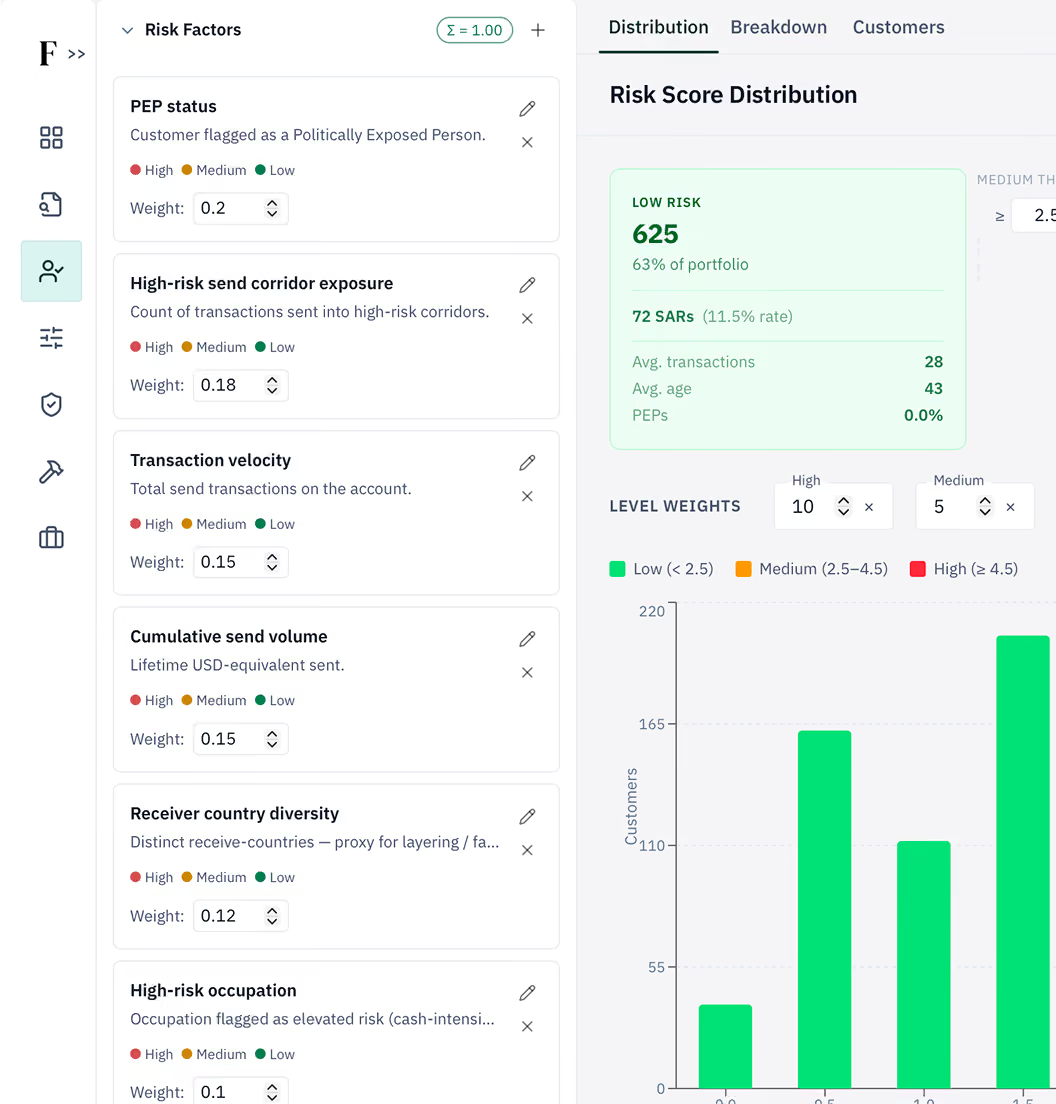
Evolve your model with confidence
Test changes and immediately see their impact on scores and alerts before rolling them out.
Defend every risk decision
Each score includes a clear breakdown of contributing factors – so you can explain outcomes to the regulator with confidence.
One connected workflow that keeps risk current at every stage
Manage customer risk across four stages. Each one builds on the last – so your risk view is always current, your monitoring always aligned, and every decision always explainable.

Start every relationship with a clear, defensible risk rating
Assess and document customer risk using profile data, geography, intended product use and screening results – before a single transaction takes place.
Use risk ratings in your monitoring rules from day one – higher-risk customers get tighter thresholds automatically.
Trigger enhanced due diligence for high-risk customers with a clear handoff to your EDD workflow
Every classification is explained and stored for your audit log
Risk ratings that update when behaviour changes
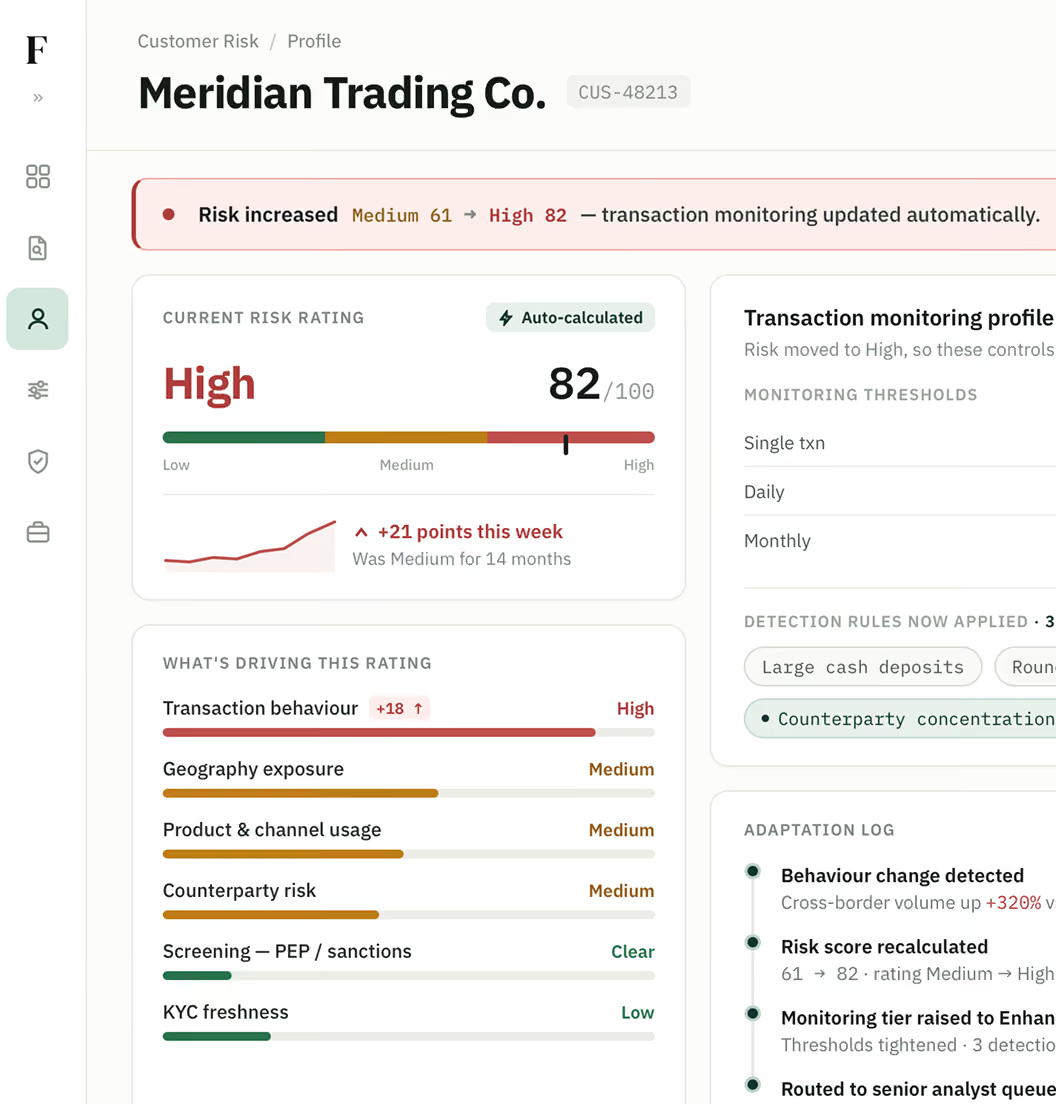
Recalculate risk automatically as transaction behaviour, screening results and customer data change. You define the trigger events that matter – large transactions, jurisdiction changes, adverse media matches, new product usage – and the system reassesses risk when they occur.
Risk ratings update based on trigger events you configure
Customers are reassessed automatically when behaviour deviates from expected patterns
Monitoring that adapts to customer risk in real time
Risk assessment and transaction monitoring live in the same system. When a customer's risk changes, monitoring behaviour updates immediately.
Monitoring rules adjust automatically when a customer's risk rating changes
Set different thresholds for different risk tiers directly in your rule conditions
Higher-risk customers are monitored more tightly; lower-risk customers generate fewer alerts
Explain and justify every risk decision
Every risk score is traceable – from the data that fed it, through the factors and weights applied, to the monitoring decisions it influenced.
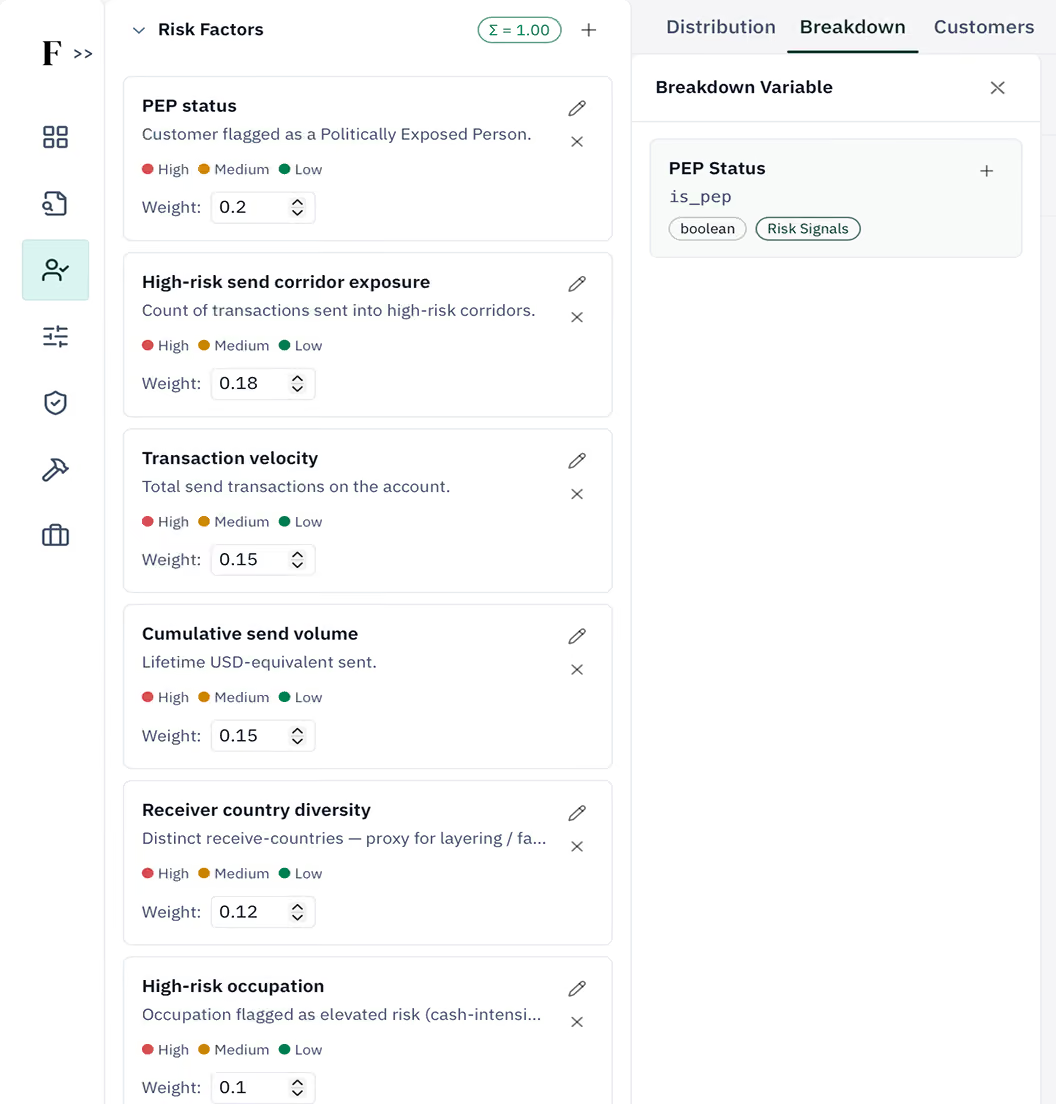
Full factor-by-factor breakdown of every score
Model-level justification showing why your weightings and thresholds are set the way they are
Complete traceability from risk rating through to monitoring outcome
Export audit packages directly from the platform
How it works
Transaction spike detected
Risk score updates in real time
Customer moves to higher risk tier
Monitoring thresholds adjust
Alert generated with full audit trail
Every change in risk is immediately reflected in how you monitor and investigate customers.
40% fewer alerts
Seconds
100% traceability

"For the first time, our monitoring actually reflects our risk view. We're not running two separate systems any more – risk scoring and monitoring are one conversation."
Risk that stays current. Decisions that hold.
A score is only useful if it moves with your customers – and if you can explain it when a regulator asks.
One connected system
When risk scoring and monitoring run in separate systems, controls lag behind behaviour. In Fortify they're native to the same platform – so when a customer's risk rating changes, monitoring thresholds adjust automatically.
Test changes before they land
Run scoring changes against historical data and see the impact on ratings and alerts before going live. No surprises.
A complete audit trail
Every score carries a full factor-by-factor breakdown – the data, the weightings, the outcome. Whether you're explaining one decision or a thousand, the evidence is there.
Dynamic customer risk profiling is built into Fortify AML
Related articles
Regulatory guidance and industry context for financial crime professionals.



Common buyer questions
From 10 July 2027, the EU Anti-Money Laundering Regulation (AMLR) applies directly in every member state. Firms must assess each customer’s money laundering and terrorist financing risk, apply due diligence in proportion to that risk, and keep the assessment current through ongoing monitoring. The new EU Anti-Money Laundering Authority (AMLA) is setting common technical standards for how this is done. Fortify’s customer risk rating recalculates as customer behaviour changes and shows the factors behind each rating, giving firms a documented, up-to-date view of customer risk for supervisors.
AMLA is the EU Anti-Money Laundering Authority, a new EU agency based in Frankfurt. AMLR is the Anti-Money Laundering Regulation, the single rulebook firms must follow from 10 July 2027. AMLA writes the technical standards that sit under AMLR, coordinates national supervisors and, from 2028, will directly supervise up to 40 of the highest-risk cross-border financial institutions. Most firms will still be supervised nationally, but to AMLR’s rules.
Not directly. UK firms follow the Money Laundering Regulations 2017, which already require a risk-based approach to customer due diligence and ongoing monitoring. A UK group with a regulated entity in the EU will need that entity to comply with AMLR from 10 July 2027, so groups operating in both will want one approach to customer risk that meets both sets of rules.
Whenever the customer’s risk changes, as well as at onboarding and periodic review. Both the UK Money Laundering Regulations and the EU AMLR require ongoing monitoring, and supervisors expect a rating to reflect what a customer is doing now. Fortify recalculates a customer’s rating when a configured trigger event happens, such as a large transaction, a change of jurisdiction, an adverse media match or use of a new product.
By showing which factors produced the score, how each was weighted and why, and what the rating changed downstream. Fortify gives every rating a factor-by-factor breakdown, records the justification for weightings and thresholds, links each rating to the monitoring outcomes it drove, and exports the full record as an audit pack.
Yes. One set of thresholds for every customer raises alerts on low-risk customers and can miss activity from high-risk ones. Linking thresholds to risk tier means a customer who moves to a higher tier is monitored more closely straight away. In Fortify, monitoring rules adjust automatically when a rating changes, and teams can test the effect on scores and alerts against historical data before rolling a change out.
See it in action
Book a 30-minute walkthrough and we'll show you how dynamic customer risk ratings keep your monitoring aligned – recalculating risk as behaviour changes, using your own scenarios.

