Fast onboarding brings customers in. Risk arrives at the same speed.
E-money institutions serve diverse customers with thin data at onboarding. As volumes grow, the gap between customer risk and your controls widens. Fortify gives fraud and AML teams what they need to close it.


Fast wallets, slow controls
As your product evolves, risk changes faster than your controls.
Flows are visible. Ownership isn’t.
Virtual IBANs mask the true account holder. Rapid wallet-to-wallet movement hides patterns before monitoring catches up. Cycling masks intent, and risk forms before it's detected.
Risk evolves, controls lag
Customer risk changes quickly, but tiered onboarding and third-party dependencies don’t keep up. Risk outgrows the initial tier and control gaps emerge. The regulatory exposure still sits with you.
One threshold doesn’t fit all
Different customers behave in different ways, but static thresholds treat them the same. Low-risk segments generate noise and high-risk activity slips through. Segmentation quickly turns into rule sprawl.
Built for fraud teams, AML teams or both.
Fraud and AML functions at e-money institutions often run on separate tools, with separate workflows and reporting lines. Fortify brings detection, risk rating, investigation and regulatory reporting into one system. For fraud, for AML or for both.
Catch coordinated abuse while it's small
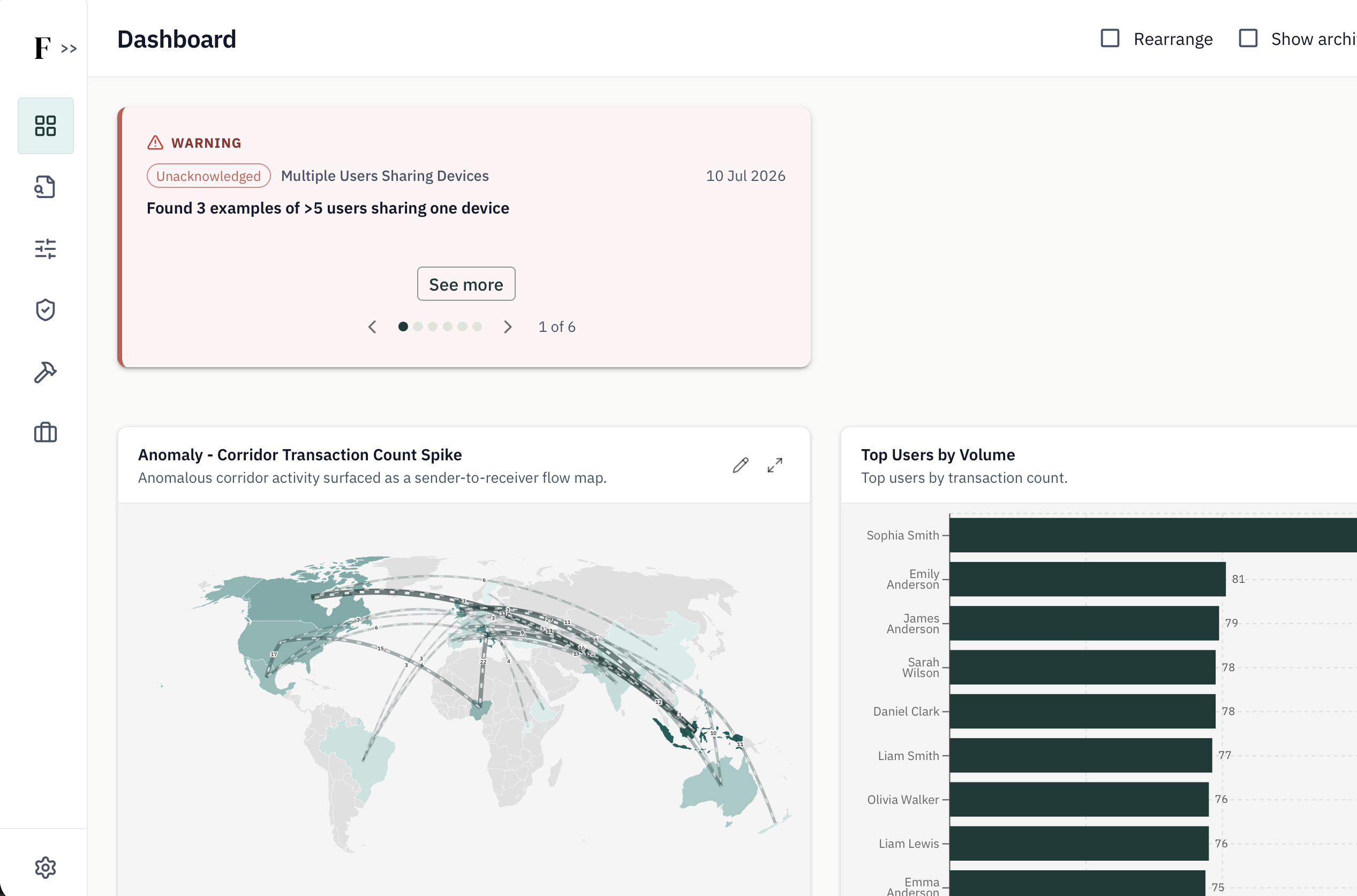
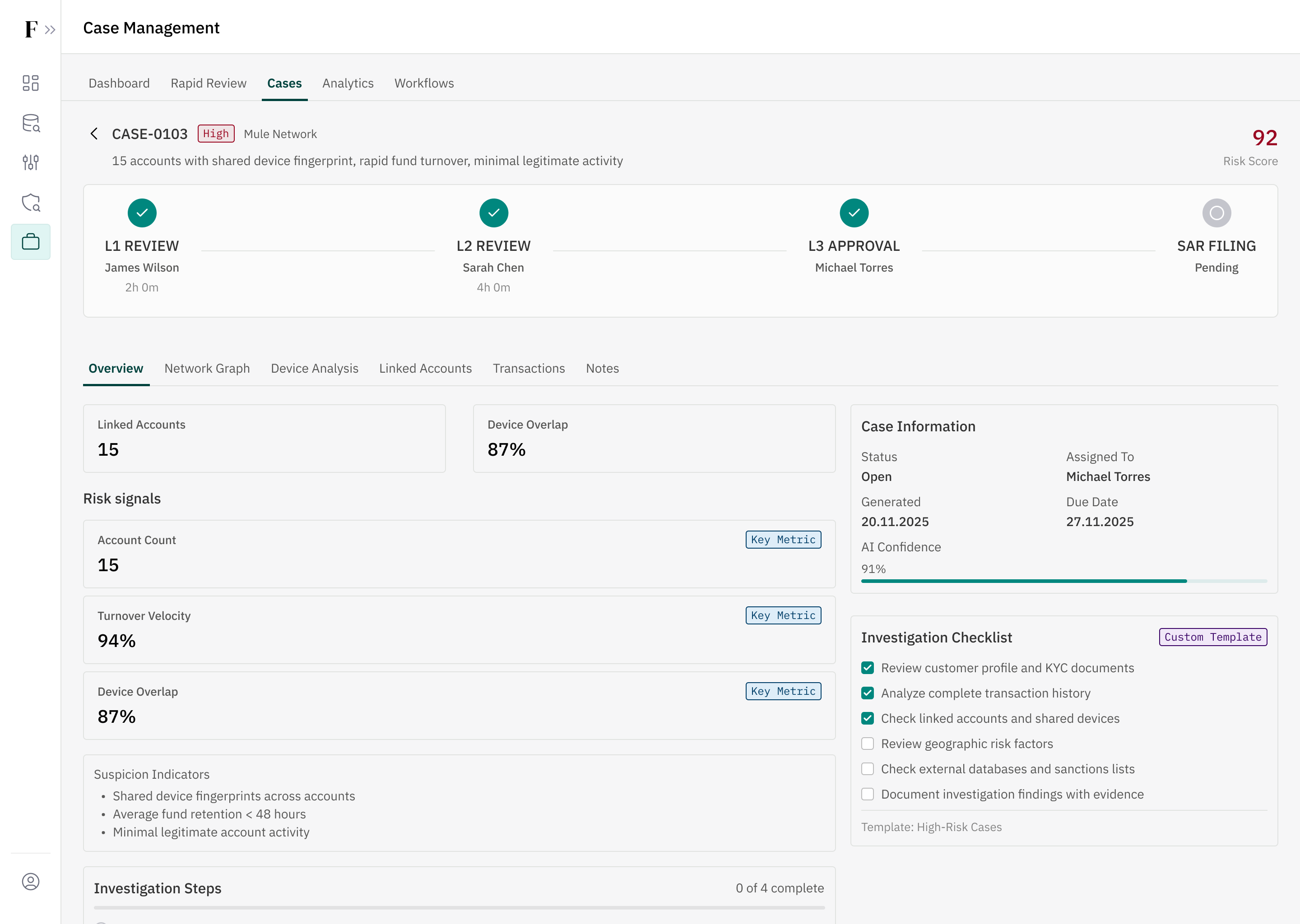
EMI fraud looks like isolated incidents until you connect it. Link signals across wallets, devices and identifiers, and the clusters, rings and rapid-movement patterns show up while they're still small.
Wallet-to-wallet and account linkage to identify coordinated abuse
Shared device and identifier signals surfaced in the case context
Prioritisation by likely loss and exposure
Rapid movement and cycling behaviour highlighted across linked entities
Tune by segment. Test before you deploy.
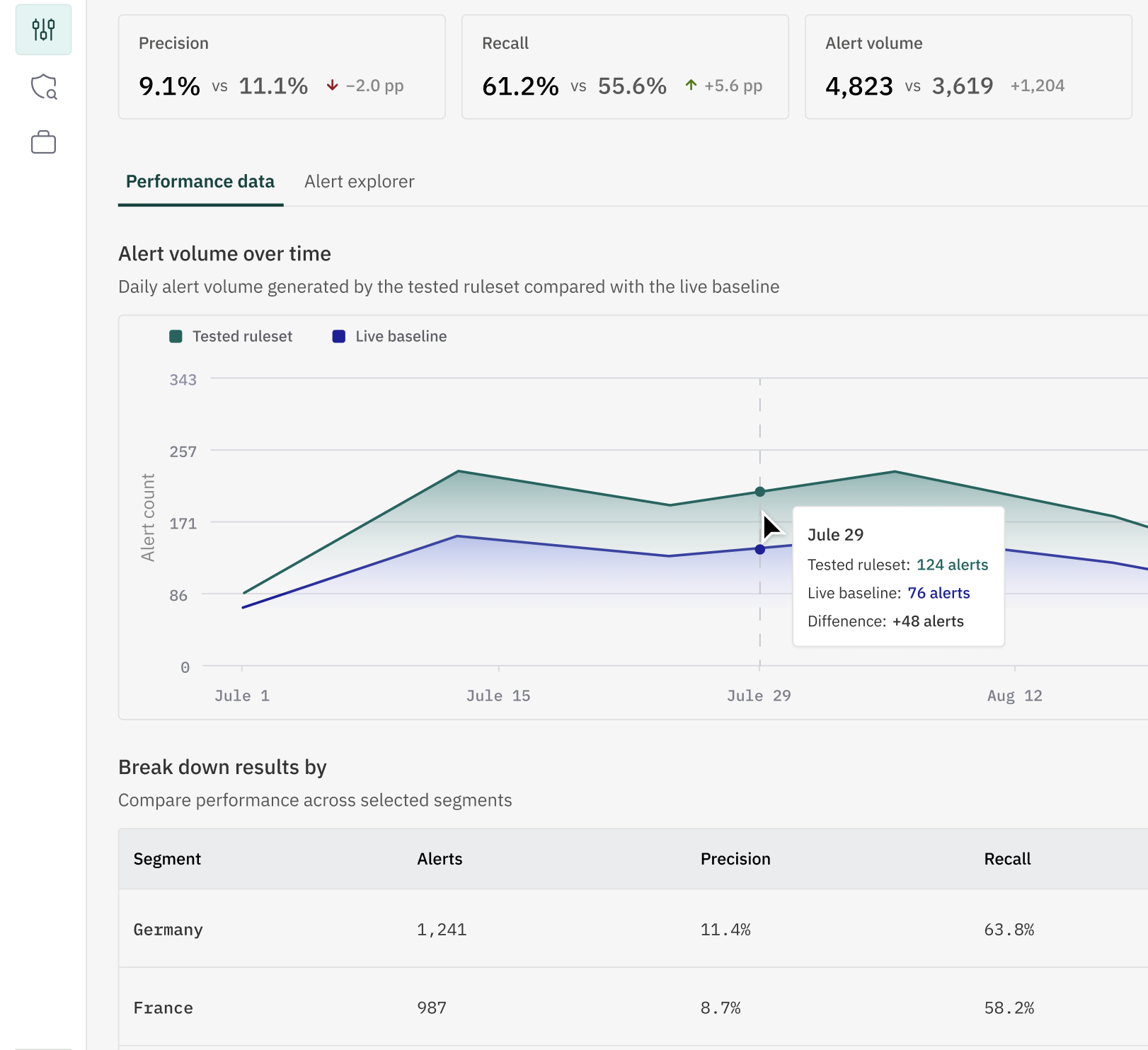
One generic rulebook creates false positives in low-risk segments and gaps in higher-risk behaviour. Calibrating controls by segment and backtesting on historical data shows the trade-offs before anything goes live.
Backtest rule and threshold changes on real wallet history
Segment controls by product, corridor, cohort, risk tier or funding method
Compare approaches side-by-side: precision, volume, operational load
Deploy updates without engineering support
Emerging pattern to tested control, same day
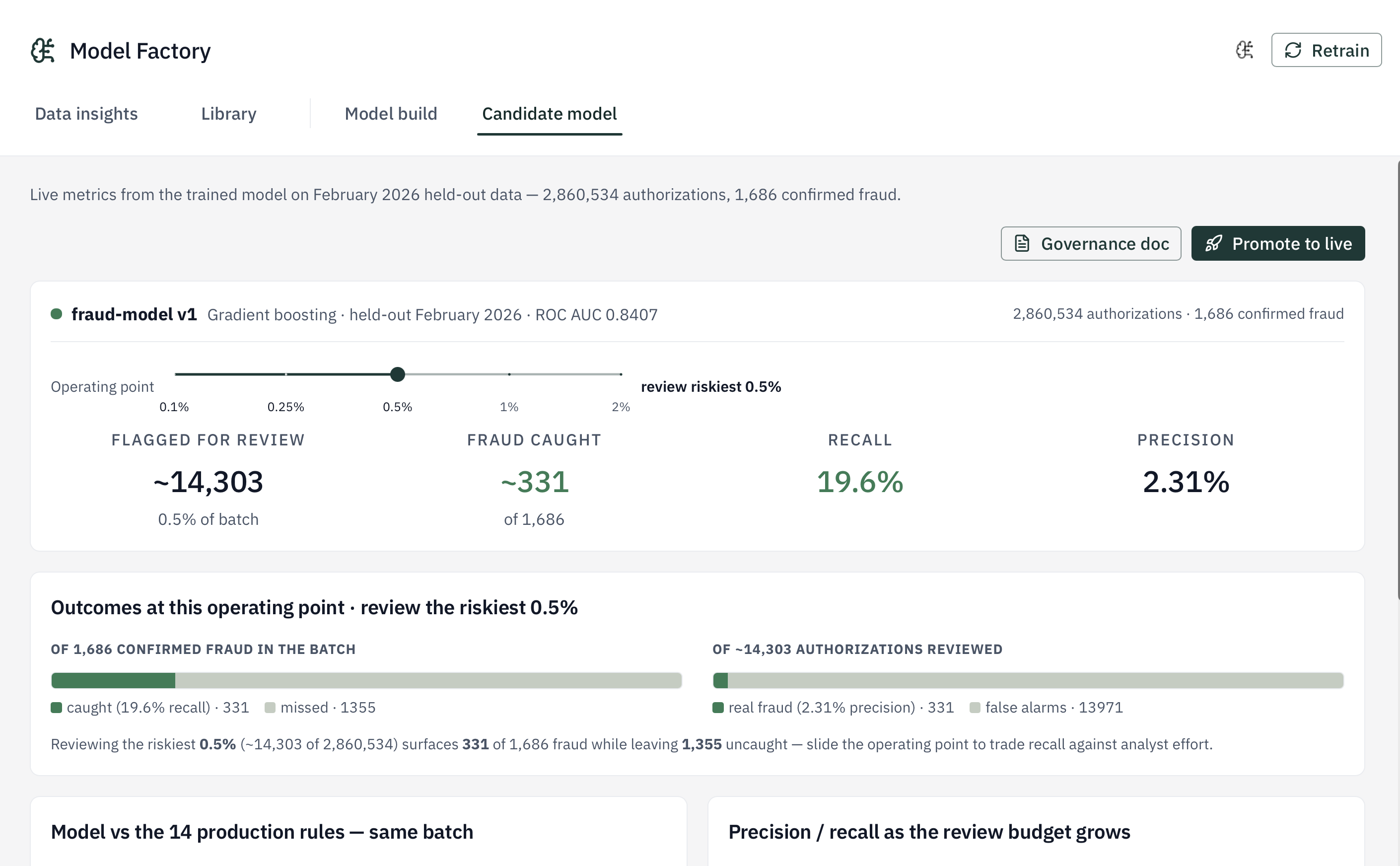
Fraud tactics shift quickly in fast, low-friction wallet environments. Translating what your team is seeing into rules or models, validating on your data, and deploying safely should take hours.
Write and amend rules in plain language, without SQL or engineering support
Retrain models from analyst-observed patterns, with human judgement in the loop
Test impact before deployment: alert volume, precision, customer friction
Clear record of what changed and why

"Wallet fraud used to look like isolated incidents until it was too late. Now we link wallets, devices and behaviour to catch mule clusters early, tune thresholds by segment, and take a new pattern to a live control the same day."

.avif)
Why choose Fortify
- 01
Risk ratings that move as fast as your customers
CRR recalculates continuously — customers don't stay on the wrong verification tier as their activity grows.
- 02
Controls your team can update without engineering
Rules can be written, back-tested and deployed by compliance directly, without waiting on vendor or engineering queues.
- 03
A team that stays alongside you after go-live
Monthly adviser sessions keep the framework calibrated as the business evolves and regulatory expectations develop.
Linked view
Fewer false positives
Same-day
Based on results from Fortify customer deployments

Risk ratings that keep up with your customers
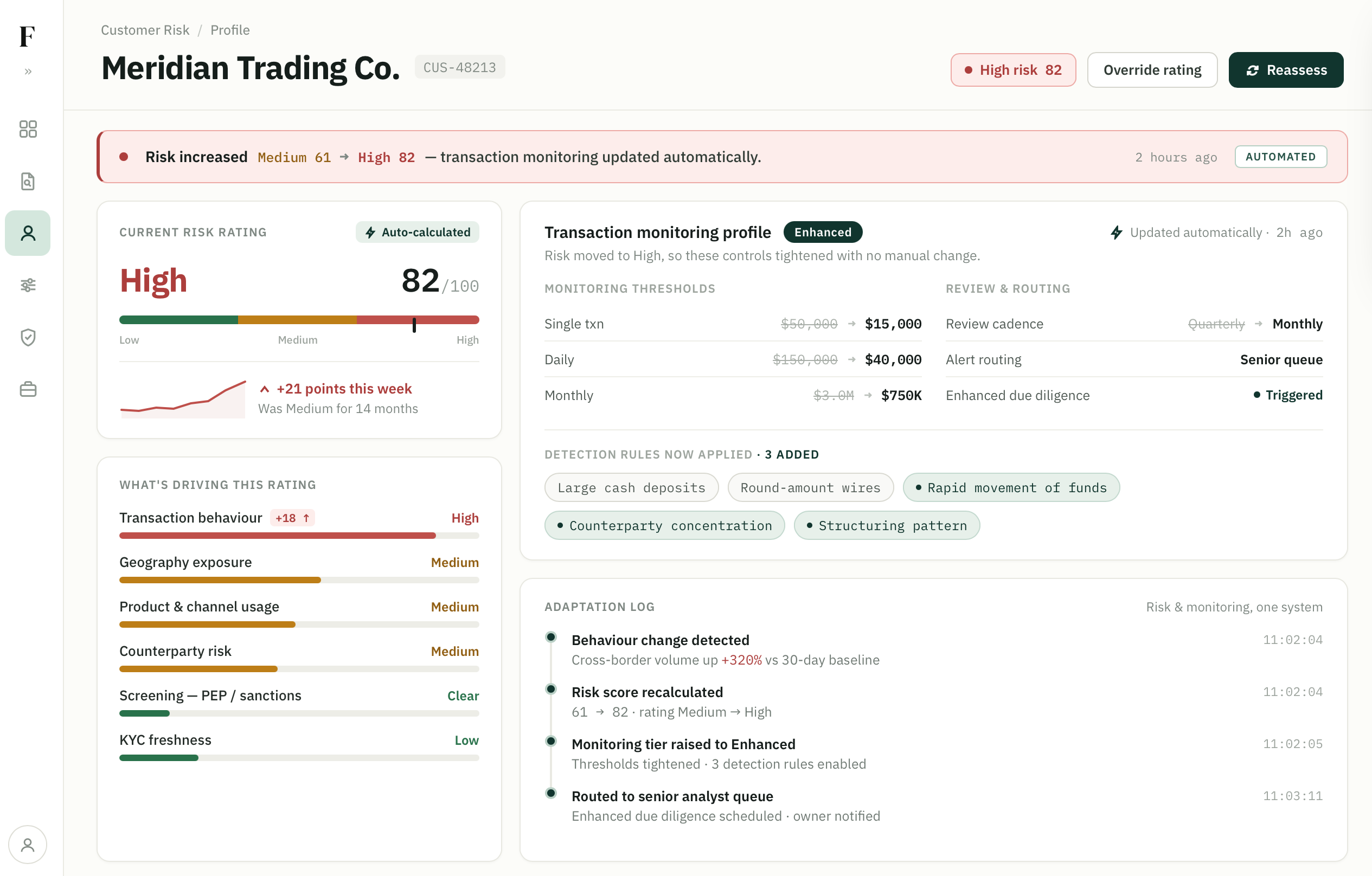
Tiered onboarding works until behaviour changes faster than your review cycle. Risk ratings that update as corridors, counterparties and behaviour shift keep monitoring and EDD triggers aligned to current exposure.
CRR recalculation as transaction behaviour and exposure change
EDD and tier-upgrade triggers that follow current risk as it moves
Monitoring thresholds aligned to risk tiers and customer types
Explainable risk drivers for review and supervisory scrutiny
Build on the signals you have. Show the gaps
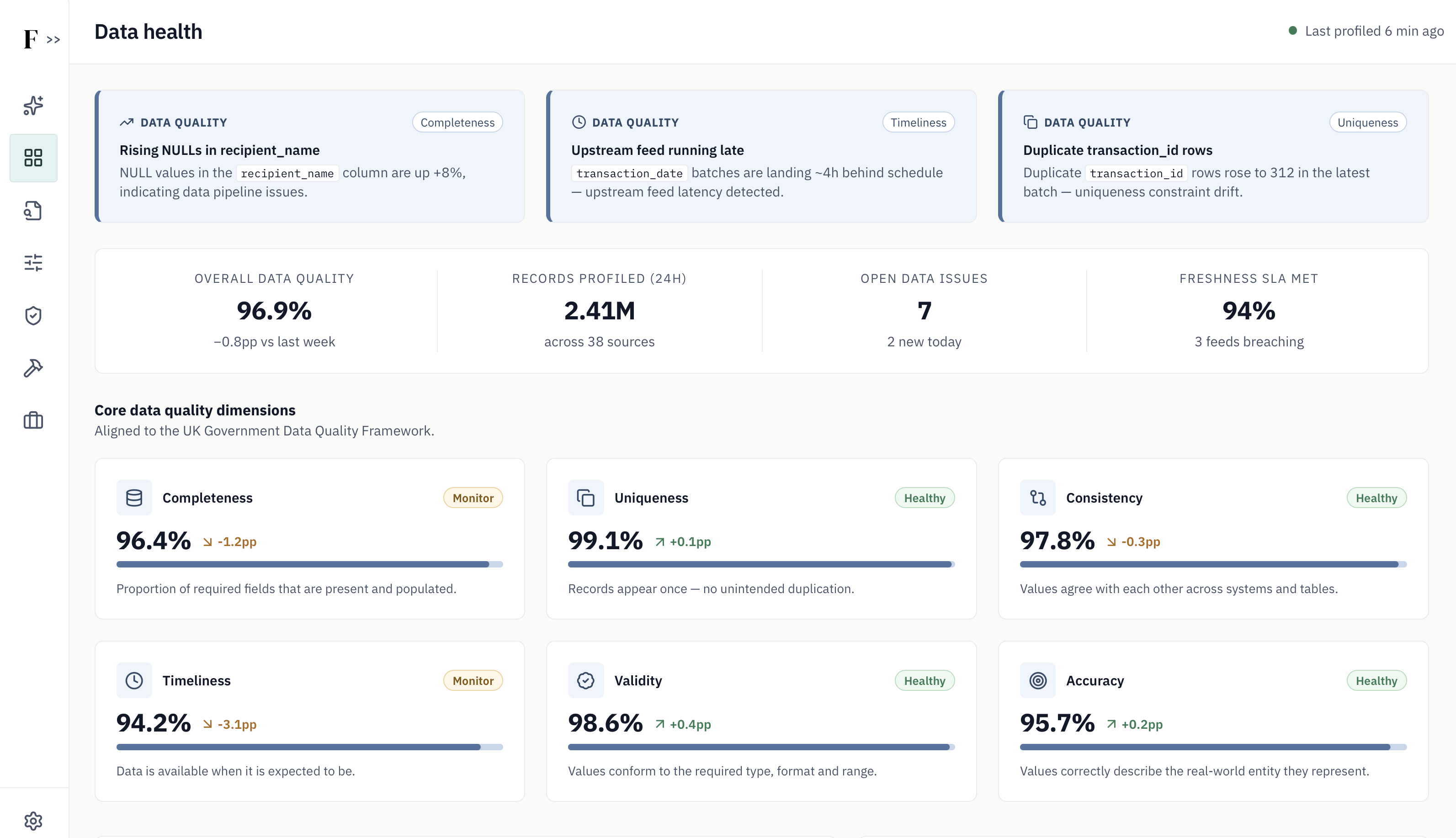
EMIs often have uneven KYC quality across products, geographies and partners. Fortify makes coverage and data gaps visible, so you can see where monitoring is noisy and where it needs work.
Coverage visibility by product, corridor, partner channel and segment
Monitoring logic tied to the data it relies on, with gaps surfaced clearly
Calibrate thresholds without creating rule sprawl
Decision rationale captures what was checked and what was unavailable
Evidence built as you work, traceable from control to outcome
Supervisors and banking partners expect defensible, consistent decisions. Structured case files and an audit trail linking controls, investigations and outcomes means exam readiness is continuous.
Structured case files capturing rationale, evidence and outcomes end-to-end
Rule-to-obligation traceability plus version history of control changes
Consistent decisioning across teams and jurisdictions
Reporting outputs generated from the workflow, without manual reconstruction
"Our customer base changes faster than a quarterly review cycle can keep up with. Risk ratings that update continuously – and show exactly why a score has moved – have made our conversations with the regulator much more straightforward."
Why choose Fortify
- 01
Risk ratings that move as fast as your customers
CRR recalculates continuously — customers don't stay on the wrong verification tier as their activity grows.
- 02
Controls your team can update without engineering
Rules can be written, back-tested and deployed by compliance directly, without waiting on vendor or engineering queues.
- 03
A team that stays alongside you after go-live
Monthly adviser sessions keep the framework calibrated as the business and the rules change.
Risk that keeps up
Coverage you can see
Always audit-ready
Based on results from Fortify customer deployments
Wallets move fast. Your controls need to keep up.
Fortify is built for the people accountable when risk enters as fast as customers do – Heads of Financial Crime, MLROs and fraud and compliance teams at e-money institutions, carrying regulatory exposure across pooled and sponsored structures. The platform is designed by practitioners who've run these functions, and backed by a team that works alongside yours in the day-to-day.
Built by practitioners
Every feature was designed by people who've sat in your seat – running fraud and compliance teams at e-money institutions, accountable for risk across wallets, virtual IBANs and thin onboarding data. The product works the way your team already thinks.
Your team + our team
Decision-making software backed by embedded expertise. Your fraud, risk and compliance teams get both the platform and the people to run it with.
Assist analysis without losing control
Risk spreads across wallets, devices and linked accounts. Surface it early, with human judgement intact.
Surface linked wallet and device patterns before they backlog
Flag rapid movement and cycling behaviour early
Link related wallets and accounts for faster investigations
Keep all actions visible and reviewable
For teams operating under regulatory scrutiny.

Step 1
Describe the attack. For example: a cluster of bank-detail changes hits your contractor population 48 hours before payday.
Step 2
Get a retrained model in minutes, built from your input and Fortify's detection logic.
Step 3
Test before deploying. Human judgement stays in the loop.
3 minutes. Not months.
One modular system for fraud and AML, built around how teams actually work
Related articles
Regulatory guidance and industry context for financial crime professionals.

.avif)


Built for fraud and AML teams managing fast-moving risk
Detection built for how e-money is actually abused, risk ratings that move with your customers, controls that keep pace with product growth.

